Western fortification walls
Back to all places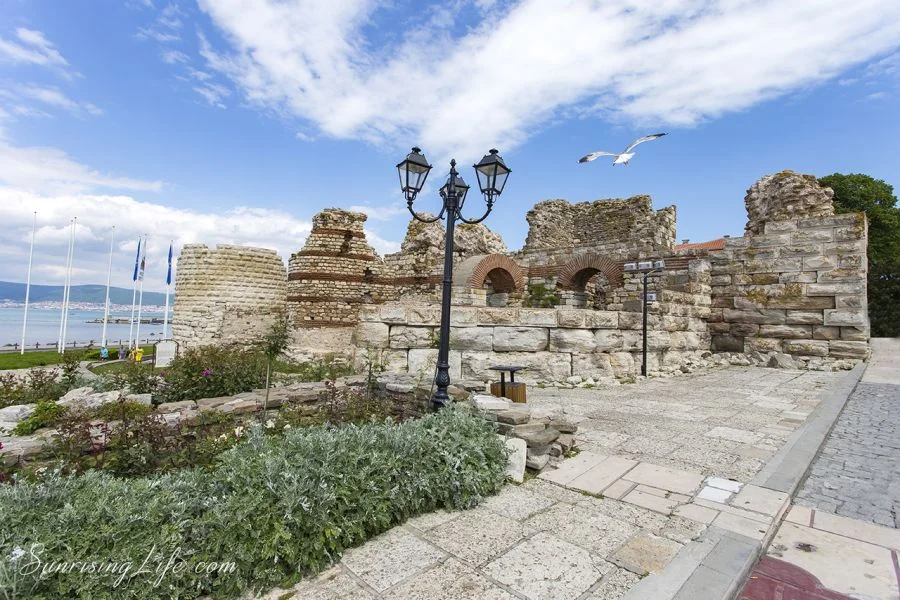
The story began over 3,200 years ago when the Thracians first fortified this strategic peninsula. However, it was the Dorian Greeks in the late 6th century BC who transformed Nessebar into a true fortress. Their walls were nearly 3 meters thick, built with precisely cut limestone blocks joined with yellow clay. The Greek walls stood outside or parallel to the later Roman walls, which you see in front of you. Today, remains from the Greek layer can be seen in the left sector of the walls, where they serve as foundations for the later wall.
In 72 BC, the city voluntarily surrendered to the Romans to avoid destruction, keeping its walls intact. But as the Roman capital moved to Constantinople, Nessebar, then called Mesembria, became a vital imperial shield. Look closely at the walls around you. You will notice layers of stone alternating with red bricks. This is the "Opus Mixtum" style. The walls are constructed using horizontal layers of shaped limestone blocks separated by bands of red bricks, characteristic of the era of Constantine the Great. During the 5th and 6th centuries, the walls were continuously thickened and strengthened to meet the threat of barbarian invasions. Under Emperor Anastasius I, this part of the wall, the most vulnerable part of the city, was reinforced to reach a staggering thickness of nearly 4 meters.
As you stand outside the fortress walls, facing the main gate, look to your left and you will see the largest horseshoe-shaped tower. This was a 5th-century masterpiece of military engineering, built separately from the main wall to withstand better earthquakes and battering rams, a design mirrored in the famous Theodosian Walls of Constantinople.
Not all sieges were successful, but in November 812 AD, the Bulgarian Khan Krum used advanced siege engines to breach these very walls. The breakthrough happened just north of the main gate, allowing the Bulgarians to capture the city for the first time. Inside they found storages of the Roman’s seceret weapon, the legendary "Greek Fire". Greek fire was an incendiary mixture that can burn even on water and was nearly impossible to extinguish. The weapon was invented in the 7th century and contained substances such as oil, resin, sulfur, and quicklime. Greek fire was launched at enemy ships, creating chaos by setting their decks ablaze, and the flames spread rapidly. By this almost mystical super weapon, a massive Viking fleet was destroyed in the 10th century, aiming to sack Constantinople. Actually, the sails of this fleet were spotted from Nessebar, and the news was sent to Constantinopol, and the ambush was set. This weapon was a closely guarded secret of the Byzantines and played a key role in the defense of the city. Luckily for the Romans, the Bulgarians didn’t manage to replicate the production of this weapon, and it was never used agains the Byzantines.
Throughout the Middle Ages, the walls were town’s constant protectors, but they also faced a much more powerful enemy- Nature. A devastating earthquake in 1063 destroyed large sections of the fortifications, which were hastily repaired under Emperor Constantine the tenth Ducas. Even during the Ottoman period, these walls remained significant, with cannons placed here as late as 1783 to ward off Russian naval landings.
By the 19th century, parts of the ancient walls were no longer needed for defense and were used as a "quarry" for new buildings, like for the building of the Church of the Holy Assumption of the Virgin Mary. However, enough remained for the world to recognize their value. In 1964, the walls were declared a national monument, and in 1983, they became a central reason for Nessebar’s inclusion on the UNESCO World Heritage List. Today, these stones tell the story of a city that refuses to die, standing as a monument to 3,000 years of human resilience and architectural genius
42.65899, 27.72972