The Old Metropolis "St. Sophia"
Back to all places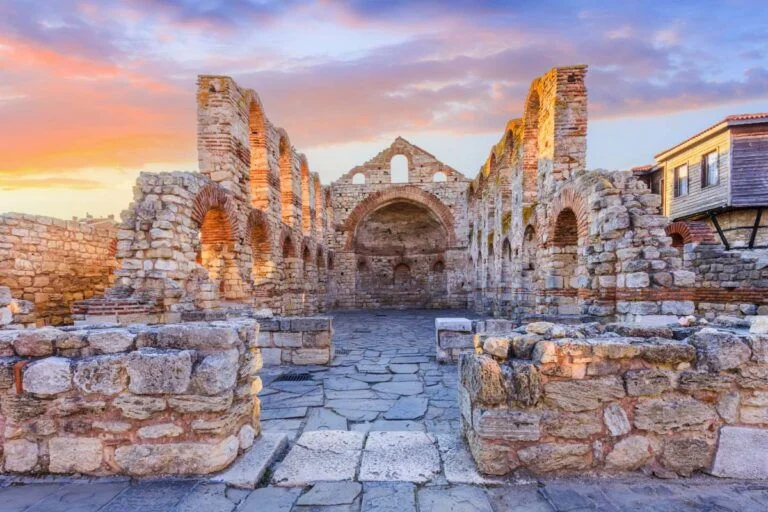
This is one of Nessebar’s most iconic symbols, the Basilica of Saint Sophia, widely known as the Old Metropolis. You are standing in the very center of the Old Town, on the site where the Ancient Agora once pulsed as the hub of political life and where the Temple of Apollo once stood. This grand three-nave Hellenistic basilica was originally erected at the end of the 5th century during the reign of Emperor Zeno. Throughout the centuries, it suffered damage from earthquakes and was repeatedly restored by great Byzantine rulers such as Anastasius I and Justinian I. The ruins you see today largely date from the first half of the 9th century, following a restoration after the Bulgarian Khan Krum’s capture of the fortress in 812. Note the architecture. The central nave was once separated from the side naves by marble colonnades, which were later replaced by heavy stone pillars connected by arches. On the northeastern pillar, at a height of 3 meters, there is an embedded marble block with an Ancient Greek inscription from Psalm 101, 102, "Lord, hear my prayer, and let my cry come unto Thee". In the northwestern corner of the central nave lies the symbolic tomb of the Byzantine princess Mataisa Palaiologina. Her nephew, Despot Demetrios Palaiologos, erected a magnificent sarcophagus for her. There is an intriguing detail here. Mataisa’s tomb was built above the floor level of the church. This was a direct violation of the church canons of the time, which required burials within churches to be level with the floor. This exception was allowed solely because of her exceptionally noble, imperial lineage. Princess Mary was the daughter of the Byzantine Emperor Andronikos the Third Palaiologos and his wife Maria. The blood of the three most powerful dynasties in the region, the Kantakouzenos, the Palaiologos, and the Bulgarian Asen families ran through her veins. At just nine years old, she was married to the fifteen-year-old Michael Asen, the eldest son of the Bulgarian Tsar Ivan Alexander. This marriage was meant to serve as a bridge between Bulgaria and the Byzantine Еmpire, but fate decided otherwise. After the early death of her husband, the princess chose a path that few of her rank would have taken. Instead of seeking another political marriage or returning to the imperial court, she took monastic vows under the name Mataisa and settled in a monastery here in Mesembria, where she spent the rest of her days in prayer and humility. The story of her final resting place continued through the centuries. In 1827, during the turbulent period of Ottoman rule, the Metropolitan of Mesembria faced a difficult decision. To save Mataisa’s tombstone from destruction or from being repurposed as ordinary building material, he moved it to the small and hidden Church of Saint Spas.
Today, the original tombstone is preserved and on display at the Archaeological Museum of Nessebar. It is far more than a piece of stone, it is a testament to a time when Nessebar was known as “The Little Constantinople,” sheltering imperial daughters and safeguarding the spirit of two empires. For centuries, this temple housed priceless Christian relics, including the holy remains of St. Theodore Stratilates. However, in 1257, a Venetian fleet seized Mesembria and carried the relics away to Venice, where they remain to this day. In 1855, the grand entrance, the propylaea, was dismantled so its stones could be used to build the modern Church of the Assumption of the Virgin Mary. Today, the Old Metropolis remains a premier example of medieval Christian architecture and stands as a vital part of Nessebar’s UNESCO World Heritage status.
Now imagine this. The year is 680 AD. The horizon near Mesembria blazes not only with the setting sun but also with the purple sails of the imperial fleet, carrying within it the fate of the Christian world. The Basileus himself, Constantine IV Pogonatus, the embodiment of Christ’s earthly power, arrives here at a critical moment, before the decisive clash with the Bulgars of Khan Asparuh at the Ongal area. The Emperor leads his retinue to the city’s spiritual core, the grand Basilica of Saint Sophia. Imagine the solemn procession making its way through the crowded ancient Agora. The air is saturated with the scent of expensive incense and the heavy silence of the gathered people. Inside the temple, beneath the massive vaults of the three-nave basilica, the light of hundreds of candles reflects off the polished marble of the colonnades. From the high balconies of the gynaeconitis, the women’s section, noble ladies dressed in silk and gold watch with bated breath, while below, strategists, and ordinary fishermen stand separated, yet united by a single common prayer. In the center of the nave, before the altar where the miraculous relics of the holy warrior Theodore Stratelates are kept, the Metropolitan of Mesembria begins the Divine Liturgy. His voice echoes solemnly beneath the wooden roof, offering a fervent plea to Almighty God for a miracle and victory over the "newly arrived barbarians" who dare to tear the living flesh of the sacred Christian empire. In this fateful moment, the Emperor’s gaze rests upon the marble block embedded high in the northeastern pillar, where the words of David’s Psalm echo like an oath: "Lord, hear my prayer, and let my cry come unto Thee". The Basileus, though tormented by physical pain due to his medical condition, stands steadfast—a symbol of a civilization that believes in its divine mission. When the service concludes, the spirit of Mesembria remains forever sealed within the stone walls of Saint Sophia, an eternal witness to the day when the history of the Balkans was decided here. With the blessing of the holy relics and the power of communal prayer, Constantine IV sets off for the northern shore to lead his troops into the unknown of Ongal, leaving behind a city transformed into a true Christian stronghold. Luckily for us, those preparations were not enough, and the imperial forces suffered a decisive defeat by the Bulgarians, which opened the possibility for a new kingdom to be born.
42.65911, 27.73592