The Imperial Roman baths
Back to all places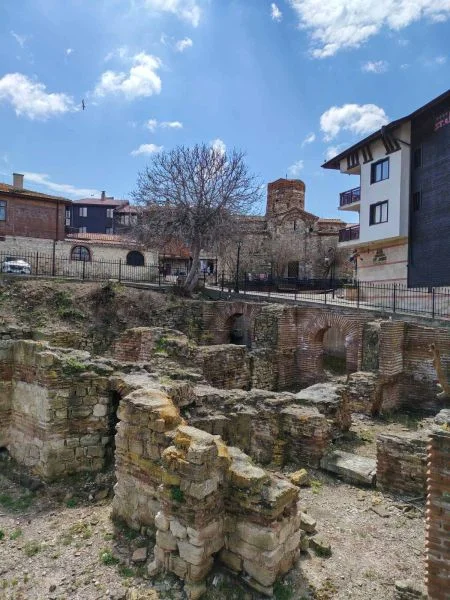
In the 6th century, Mesembria was not just a port; it was called "Little Constantinople"—a brilliant bastion of the Byzantine Empire whose rhythm was dictated by the sea and imperial decrees. In the northern part of the peninsula, just above the harbor, rose one of the city’s engineering wonders: the Imperial Baths. This was not just a place for washing, but the beating social heart of Mesembria.The Journey of the so-called Magic Water began at the hot springs of Aqua Calidae, which are forty kilometers Southwest of the town. In order to bring the water from the springs to the very heart of the city, the architects of Justinian the First erected a massive masonry aqueduct that crossed hills and valleys, guided solely by a precise gravitational incline. Upon reaching the peninsula, the water descended below sea level via clay pipes, and following the physical principle of communicating vessels, it naturally filled the bath pools located at the city’s lowest point.
In the palaestra, a vast hall measuring 16 by 16 meters, lined with luxury marble from the imperial quarries on the island of Prokonnesos, the air was thick with the scent of expensive oils and the hum of conversation. Under these vaults, citizens discussed politics, listened to poets, and brokered deals that decided the fate of the ships in the harbor. For the wealthy, the ritual began in the apodyterium (dressing room), where slaves guarded their clothes; theft was so rampant that walls were sometimes covered with "curses" scratched onto lead tablets to punish the thieves. The true sensory experience awaited in the caldarium hot rooms, where hypocaust technology turned the floor into a glowing surface heated by hot air circulating from the furnaces. Inside the thick steam, bathers did not use soap, instead, they applied olive oil and scraped away sweat and impurities with a metal tool called a strigilis. These baths were so renowned for their healing properties that in 680 AD, Emperor Constantine the Fourth Pogonatus himself chose Mesembria as a temporary residence to treat his gout in these baths. The glory of the baths lasted for centuries until one night in 1063, when the earth shook with terrible force that broke the aqueduct and destroyed parts of the fortress walls, causing the giant organism of the baths to cease functioning forever. Today, as you pass the ruins, you can still see the bricks bearing the imperial seals of Justinian, silent witnesses to a time when Nessebar was a center of health and wellness.
Later, the Ottomans, inspired by the Roman baths, erected a small hamam – Turkish bath, next to the thermae, which still stands, but it’s closed for visitors.
42.65940, 27.73416