The Church of St. Paraskeva
Back to all places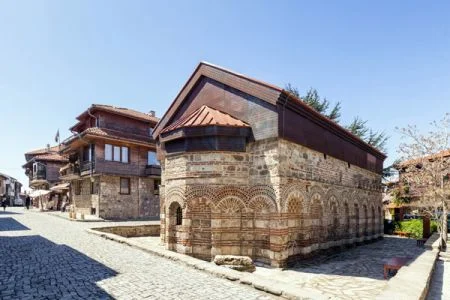
Тhe Church of St. Paraskeva, one of the most refined examples of medieval temple architecture in Nessebar, dating back to the 13th and 14th centuries. As an architectural type, it is a single nave church featuring a narthex, a construction model that traces its roots back to 11th-century Constantinople. What immediately catches the eye is its rich ceramoplastic decoration, executed in the "pictorial style" characteristic of the city. The facades are organized into two horizontal belts: the upper one consists of rhythmic "Lombardic arcades," while the lower one features blind arches framed by glazed ceramic "cups" and quatrefoils. The vibrant contrast of colors, achieved by alternating white limestone blocks with red bricks, transforms the temple into a true masterpiece of medieval art. The history of its roof is particularly interesting; originally, the church was domed, but after a collapse in the 16th century, it was covered with its current wooden gabled roof, a reconstruction reportedly sponsored by a prominent noble lady. A bell tower once rose above the narthex, and researchers still engage in a fascinating debate over whether its stylistic origins are Bulgarian or Serbian. One of the most captivating details is found on the eastern side of the temple, to the left of the apse. Embedded at a height of about 4 meters is a marble block with an Ancient Greek inscription in the Doric dialect, dedicated to the god Poseidon Asphaleos—the ancient protector of the city against earthquakes. This block serves as profound evidence of the continuiation between eras, marking the site where the oldest ancient temple on the peninsula once stood. Finally, we cannot overlook a charming local tradition preserved in folk memory. In the past, only baby girls were baptized in the Church of St. Paraskeva, while baby boys were taken to the nearby Church of the Holy Archangels Michael and Gabriel.
42.65959, 27.73561