The Basilica of the "Holy Mother of God Eleusa"
Back to all places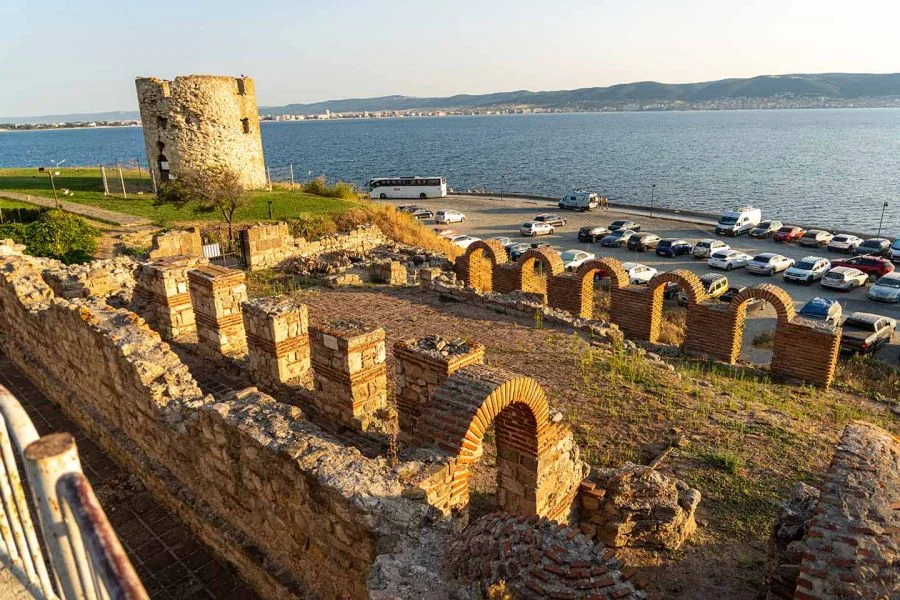
You are now in the northern part of the Nessebar peninsula, on the very shore of the sea, before the imposing ruins of the Basilica of the "Holy Mother of God Eleusa". This sanctuary, originally erected in the 6th century, was the heart of a monastery complex that existed until the 15th century, and today it remains one of the most valuable monuments of early Christian culture in Nessebar. Architecturally, the temple is a three-aisled basilica of the Hellenistic type. It is extremely important to note that this was the first church in Mesembria with three apses, an architectural novelty prompted by specific dogmatic changes in Orthodoxy at that time. The history of the temple is closely intertwined with the era of the Second Bulgarian Kingdom, and specifically with the reign of Tsar Ivan Alexander, who issued a deed of gift charter transferring the monastery to the Tarnovo Patriarchate while preserving its high “royal” status throughout the centuries. It was to this basilica that the famous miraculous icon of the "Holy Mother of God Eleusa" or The Merciful, belonged, for which the Bulgarian ruler donated precious silver and gold cladding featuring four donor inscriptions. Today, the ruins of the basilica are part of a historical zone on the peninsula where marine transgression has left its mark, but at the same time, the latest archaeological research in the area reveals new structures and remains of windmills that enrich the multi-layered history of this site.
During the reign of the Bulgarian tsars Ivan Asen II, Theodore Svetoslav, and especially Ivan Alexander, Nessebar experienced a golden age. The magnificent examples of medieval churches and the rich archaeological material are a vivid illustration of the prosperity and cultural rise of medieval Nessebar in the 13th–14th centuries. The artistic crafts also developed on a large scale.
Following Ivan Alexander’s victory at the Battle of Rusokastro in 1331 and the subsequent defeat of Byzantine forces, the city’s residents welcomed the Bulgarian tsar warmly, and Mesembria became permanently integrated into the Bulgarian state. During this era, the city established itself as a "spiritual hearth" of Christian culture and a cultural center of global importance. Tsar Ivan Alexander was an exceptionally generous patron and donor to local holy sites. He issued a special royal charter for the "St. Mary Eleusa" Monastery, which unfortunately does not exist today, placing it under the protection of the Bulgarian Patriarchate and confirming its status as a royal and patriarchal monastery. The Tsar and his uncle personally donated precious silver and gold cladding for the miraculous icon of St. Mary Eleusa, along with numerous other valuable church vessels. The original icon is kept in the National Archaeological Museum in Sofia. However, there is a precise copy in the local archaeological museum.
The era of Ivan Alexander was also characterized by close dynastic ties with the Byzantine Empire. Located within the Old Metropolis "St. Sophia" is the symbolic tomb of Princess Mataisa (Maria) Palaiologina, the daughter of Andronicus III Palaiologos, who was married to the Tsar’s firstborn son, Michael Asen. This union merged three great imperial dynasties the Kantakouzenos, Palaiologos, and Asen families. The prosperity under Ivan Alexander left a lasting mark on the city’s architecture through the development of the characteristic "pictorial style". During this time, many masterpiece churches were either constructed or repainted, and the oldest preserved frescoes in the Church of St. Stephen, the New Metropolis date precisely from this era. Despite challenges such as the Genoese fleet invasion in 1351, Nessebar under Ivan Alexander remained a symbol of the grandeur of the Second Bulgarian Empire.
42.66105, 27.73799