The Ancient Thracian tomb also known as "The Hollow Mound"
Back to all places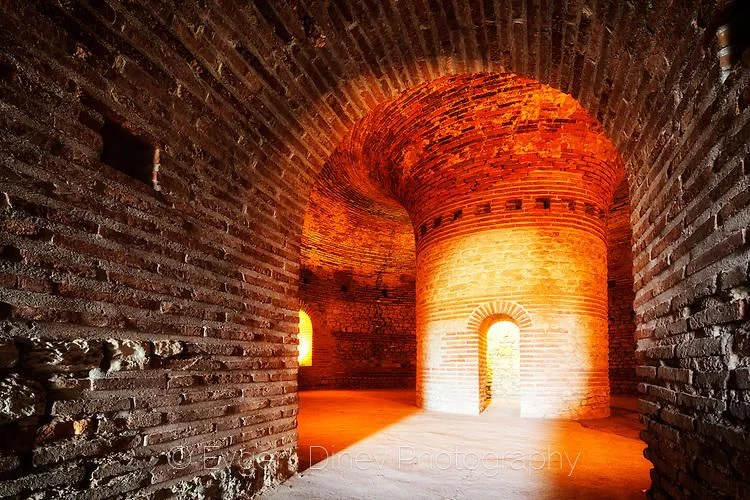
Welcome to one of the most mysterious monuments of antiquity in the Bulgarian lands. You are standing before the Ancient Beehive Tomb, located among orchards just about a kilometer from the town of Pomorie. Locals have called this place "The Hollow Mound**"** for centuries—a name hinting at the vast empty space hidden beneath the earth. Before you is a mound 8 meters high with an impressive diameter of 60 meters, which conceals the largest Thracian beehive tomb ever discovered in Bulgaria. It is unique not only for the country but for the entire Balkan Peninsula, as it combines Thracian building traditions with Roman architecture from the second – third century AD.
As you enter through the entrance on the southern side You will see before you the dromos—an underground corridor 22 meters long. Note its construction: it is built of stone and bricks bonded with pink mortar. As you walk through, you will see the semi-cylindrical vault, which is nearly 2.40 meters high. In the past, there was a double door here, and traces of its repeated opening and closing are still visible today. This corridor symbolically leads us from the world of the living into the silence of eternity.
Leaving the corridor, you enter a massive circular chamber with a diameter of over 11 meters. The first thing that catches the eye is the massive hollow column in the center. It is 3.30 meters wide at its base but widens at the top like a mushroom stalk, merging seamlessly into the outer wall of the dome. Inside the column itself, there was once a spiral stone staircase that led all the way to the surface of the mound. The architecture here is so perfect that some researchers compare it to the Pantheon and the mausoleums of Emperors Augustus and Hadrian in Rome.
Look at the circular wall of the hall. There are five symmetrical niches where it is believed the urns containing the ashes of the deceased were placed. It is thought that this facility served as a mausoleum or a heroon—a temple for the deification of a wealthy family from ancient Anchialos - present day Pomorie. An interesting hypothesis suggests the site was also a sanctuary of the god Sabazius - a Thracian diety of life, health and fertility. Through special openings in the vault, sun rays would penetrate inside at specific moments, such as during equinoxes, symbolically illuminating the altar.
Despite its grand scale, the tomb remains shrouded in mystery. When it was revealed in 1888, no bones, sarcophagi, or gold treasures were found—it had been looted in Antiquity. Today, we can only see small fragments of the original painting, colored in dark green, which once covered the walls. There are even bold suggestions that the remains of Emperor Maximinus Thrax might have been placed here, though this remains only a hypothesis.
Before you
leave, listen to the incredible acoustics of the hall. The Ancient Beehive Tomb is a monument of national importance and part of the "Via Pontica" cultural route. It stands as a reminder of the skill of ancient builders who managed to erect this eternal creation, which has survived for nearly two millennia.
42.56568, 27.59631