Moskoyani’s house and Modern history of Mesebria.
Back to all places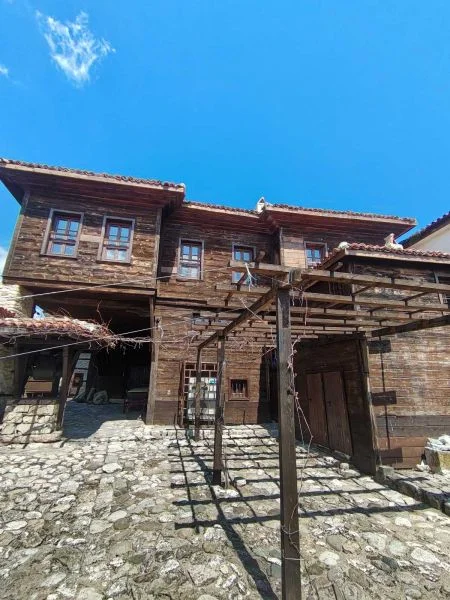
From the late 18th and early 19th century, the population of the town was around 5,000 people, of whom only about 400 were Turks, while the rest were Greeks. During this period, Mesembria once again began to stand out as a significant commercial center. The town had its own merchant fleet. More than one hundred large ships, most of which were built in a local shipyard and commanded by local sailors, sailed in the waters of the Black, Aegean, and Mediterranean Seas. Trade mainly involved wine from the local vineyards around the town and timber from the nearby mountains, used for shipbuilding and firewood. These goods were exported primarily to Istanbul, Romania, and Moldova. Mesembria also had a large storage warehouse for trade goods, which turned the town into the largest commercial center in the region during the 19th century.
Regarding education, after the town was conquered by the Ottomans, children were taught only in the vestibules of churches or in the homes of priests, learning basic Greek grammar so that they could read from the book “Acts of the Holy Apostles” and recite the Creed during church services. It was not until 1861 that the first secular Greek school was established in the town by the wealthy Mesembrian Alexandros Koumbaris, who had settled in Odessa, then part of the Russian Empire, today in Ukraine. This passionate patriot donated sufficient funds for the school’s maintenance and supplied its library with rare and valuable books. However, the school did not last long due to divisions among the local leaders who governed the community at the time.
Mesembria also becamе a cell of the Greek revolutionary organization Filiki Eteria. According to a local legend, when the uprising broke out in 1821, a Turkish force entered the town. They captured the most prominent citizens and took them outside the town to hang them from a maple tree. When they reached the tree, lightning struck it, and the body of another already hanged conspirator, who was from another place, fell from it. The bloodthirsty Turkish pasha was so frightened that he saw this as divine punishment and ordered the atrocity to stop. The immediate release of the captives was also greatly aided by the intervention of a sultan’s envoy, who had previously received benefits from the local inhabitants. Thus, the local leaders saved their lives, although all their movable property was confiscated. Apart from this incident, during the uprising, many local residents were forcibly taken by the Turks to serve in the Ottoman fleet, as they were experienced sailors.
During the uprising, one of the most distinguished citizens of Mesembria was the older brother of the already mentioned Kyriakos Koumbaris. He was born in Mesembria in 1760 and showed early intelligence and courage in maritime trade. In a short time, he became so successful that he settled permanently in Istanbul. There he became acquainted with the ideas of Filiki Eteria and joined the organization, which entrusted him with the safekeeping of its funds and important documents. During the uprising, this wealthy Mesembrian used his numerous merchant ships and personal connections with influential Ottoman officials to save many Greeks living in the capital from Turkish reprisals.
In 1828, the Russian Empire, seeing itself as a protector of Orthodoxy, came to the aid of the Greeks and declared war on the Ottomans. During the war, the town was captured by the Russian fleet under Admiral Greig and occupied for six months. During this time, the Russians took many valuable antiquities from the town, which can still be seen today in the Hermitage Museum in Saint Petersburg. After the war, many local Greeks who had actively supported the Russians left the town together with the withdrawing troops and settled in Russia. The population then dropped from 5,000 to 1,800, and the town became largely deserted. Nevertheless, many Mesembrians later returned to help their fellow citizens and relatives and to donate funds for education, as was the case with Alexandros Koumbaris.
In 1877, a new war broke out between Russia and the Ottoman Empire, this time for the liberation of the Bulgarians. It ended in victory for Russia, and as a result, Bulgaria reappeared on the political map of Europe after nearly 500 years. However, shortly after the Liberation, at the Congress of Berlin in the summer of 1878, the territory of present day Bulgaria was divided into Northern and Southern parts, with the Balkan Mountains forming the border. The lands north of the mountains, together with the regions around Sofia and Kyustendil, became part of the vassal Principality of Bulgaria, while the lands south of the mountains formed the autonomous province of Eastern Rumelia. In 1885, the two were united.
These events directly affected the fate of Mesembria. The town’s status changed, from a district town it became an ordinary administrative center subordinate to Anchialos, today Pomorie. This was due to the depopulation following the wars. Trade also declined, forcing some families to move to Pyrgos, today Burgas, which was developing into a regional center, while others moved to Constantia on the Romanian Black Sea coast. For the remaining population, fishing and viticulture remained the main livelihoods. The maintenance of the two Greek schools, one for boys and one for girls, was also carried out with great difficulty.
Despite the difficult economic situation, the first Bulgarian school opened in the town in 1880. At that time, 50 children attended the Bulgarian school, while 120 boys and 100 girls studied in the Greek schools. Education in Greek continued until 1906, when it was banned by law. This was directly related to rising anti Greek sentiment in the country due to anti Bulgarian propaganda in the region of Macedonia. That same year, after Bulgarian bands burned nearby Pomorie, they came to Mesembria and demanded that the metropolitan church “Holy Mother of God Life-Giving Spring”, now the Metropolitan Church of St. Stephen, be handed over to the Bulgarians. The local Greeks, frightened by what had happened in Pomorie, agreed. Due to the rising tensions, some families decided to emigrate to the Kingdom of Greece, while the situation for the rest remained unchanged until 1919.
After the end of World War I, Greece acquired Southern Macedonia and Thrace, where more than 100,000 Bulgarians lived. These people began to be repressed in a manner similar to how the local Greeks had been treated here. This led to a series of agreements for population exchange between Bulgaria and Greece. Thus, between 1919 and 1925, most of the local Greeks, with few exceptions, emigrated to Greece, where they founded the town of Nea Mesembria, located about 40 km northwest of Thessaloniki. In turn, their empty houses were occupied by Bulgarian refugees from Thrace and Macedonia, the first of whom arrived in 1924. This marked the beginning of the development of the new town, where the descendants of the first settlers have now lived for more than 100 years.
Today, there are almost no differences between the few remaining Greeks and the predominantly Bulgarian population from Thrace and Macedonia, as many of them have become related through intermarriage.
In conclusion, the history of Mesembria between the 18th and 20th centuries shows how a once flourishing commercial and cultural center gradually underwent significant demographic, economic, and political changes. Despite its initial rise as an important port with developed maritime trade, the town was heavily affected by wars, migrations, and national conflicts. These processes led to depopulation, economic decline, and changes in the ethnic composition of the population. Ultimately, following the population exchange between Bulgaria and Greece in 1919 1925, the town acquired a new character, becoming predominantly settled by a Bulgarian population. Despite the difficulties, Mesembria managed to preserve its continuity, and today the different communities have largely blended into a single whole.
Built in 1840 it belonged to a wealthy Greek merchant. Panayotis Moskoyanis. The house has a small yard facing the sea, paved with stones. The ground floor has a large cellar and a barn to the North. The southern part of the ground floor is divided into two levels. A stable for domestic animals on the lower level, a storage and servant’s room on the upper one. The residental floor has a large living room in the center, a kitchen, a larder and a hearth room to the north, as well as two other rooms to the south. The wooden ceiling of the living room is richly decorated with applied laths, forming a rossete with a star motif in the center. The plan of the building is symmetrical. The exterior layout of the house is simple and restrained, inconsistent with the inner richness. Today, the house hosts many exhibitions of Bulgarian costumes not only from the town and the surrounding areas, but also from all over the country and the homelands of the Bulgarian refugees.
42.65838, 27.73629