Church of St. John Aliturgetos
Back to all places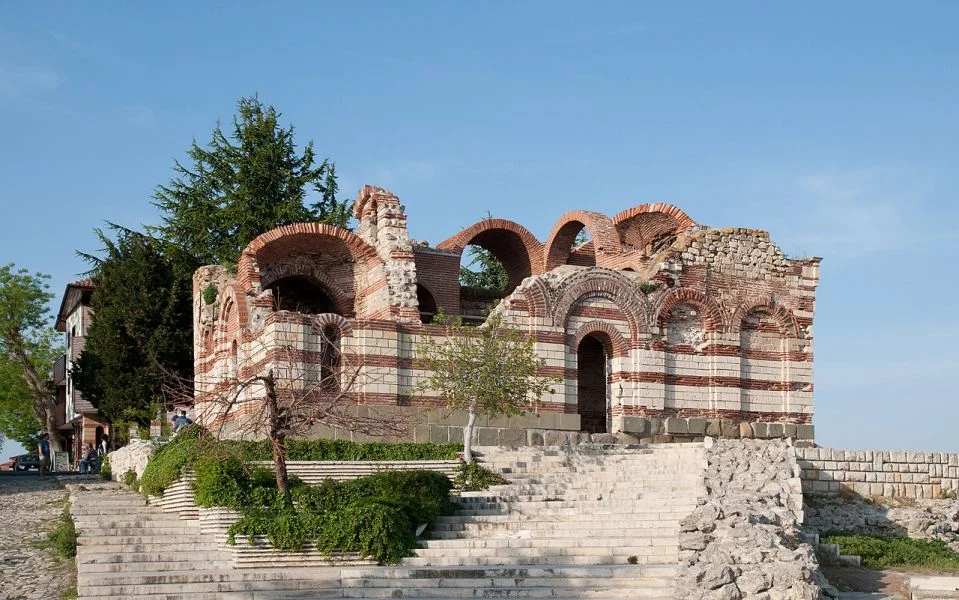
You are standing before the Church of St. John Aliturgetos, located on the steep southern shore of the peninsula, in proximity to the ancient port. Built in the 13th and 14th centuries, it is considered one of the most beautiful examples of medieval architecture in Nessebar. Its name translates to "Unconsecrated," and folk memory preserves a legend that a worker died during construction, which meant that, according to canon law, services could not be held in the temple. Another legend tells of a Turkish pasha who, drawn to the majestic dome, wished to convert the church into a mosque but perished in a shipwreck before he could fulfill his plans. Architecturally, the temple is a cross-domed church of the so-called Constantinople type, with four central columns that once supported a massive dome. Its facades are a true masterpiece of the "pictorial style," characterized by a masterful alternation of white limestone blocks and red bricks, complemented by belts of colored glazed ceramic bowls and quatrefoils. The eastern facade is the most richly decorated, while the southern one, facing the sea, is more modest. On the keystone of the main entrance, a relief image of Christ is still visible, and on the western facade, one can see the figure of a man with his hands on his waist.
Important historical evidence is sealed within the walls of St. John Aliturgetos, such as an embedded marble relief of a winged lion, the symbol of the Venetian patron St. Marko, which confirms the presence of a Venetian trade colony in the city. Medieval graffiti are also preserved on the exterior walls, including the coat of arms of Count Amadeus VI of Savoy and numerous drawings of ships. Although the temple was heavily damaged by an earthquake in 1913, its ruins remain one of the most iconic symbols of Old Nessebar.
42.65734, 27.73314