Church of Saint Spas
Back to all places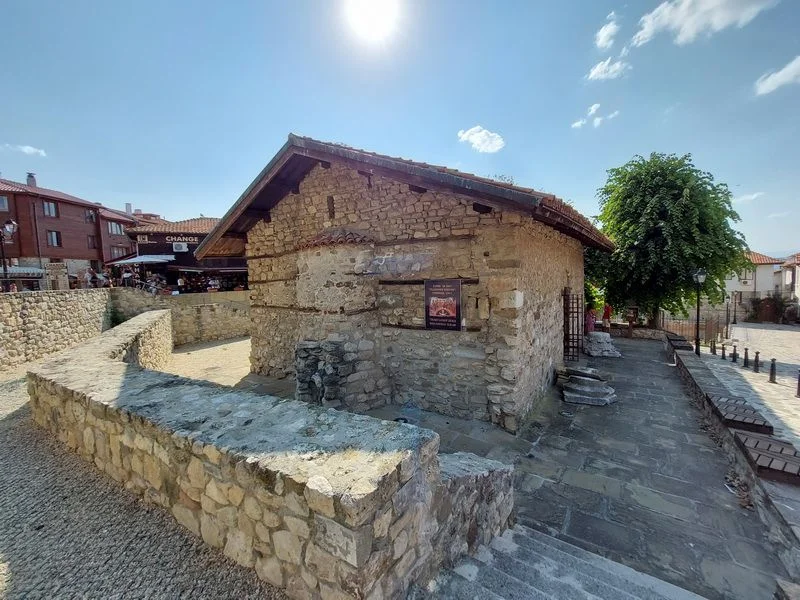
This small and seemingly modest temple was erected in 1609 and stands as one of the most valuable examples of Christian architecture and art in Nessebar from the Ottoman period. The building is typical of its time, low slung, single nave, and single apse, constructed entirely of stone. This is because during the time of the Ottoman empire was prohibited for Christian churches to be taller than a mounted horseman. Of course, those regulations disappeared in the later centuries of Ottoman rule. That is why many churches were partially dug into the ground, making them appear low from the outside but taller on the inside. Despite its small dimensions, approximately 12 by 6 meters, the church holds immense historical significance. However, the true wealth of "Saint Spas" is hidden within its walls. It is one of the few churches in the city whose interior is entirely covered with frescoes, created by the local school of iconography. In the central part of the altar apse, the majestic scene of the "Virgin Mary - Wider than the Heavens" with the Infant is depicted. Along the northern and southern walls, you will see two tiers of imagery; the upper tier presents vital Gospel events such as the Resurrection and the Transfiguration, while the lower tier features full-length figures of saints, including the warrior patrons Saint Theodore Tyron and Saint Theodore Stratelates. Another fascinating historical detail is that the relics of the Byzantine princess Mary Mataisa Paleologina were once laid to rest here, having been moved from the Old Metropolis for safekeeping, after the Ottomans conquered the town. You can find more information about Princess Mataisa at the Basilica of Saint Sofia."
Anyway, the church of ’’Saint Spas" does not function as a place of worship today, but it has been converted into a museum site, part of the city’s architectural and historical reserve.
42.65928, 27.73453